
Welcome to Country Ceremony

What is a Welcome to Country
Ceremony?
A Welcome to Country is an ancient tradition. Traditionally, it was a way for visitors to be recognised by the people of the land and for permission to be sought before entering Country.
Today, the ceremony has evolved. It is a way of fostering connection to Country: inviting people to pause, listen and consider the land they are standing on and the relationships that have always existed within it. For many, it is the beginning of a deeper understanding of place and of their own responsibility within it.
In accordance with Traditional Laws and Customs, the Turrbal people are the sole Traditional Owners and Custodians of Brisbane, and the only group who can rightfully perform Welcome to Country across the city. This authority comes from our bloodline connection to this place.
Official historical records confirm that the Turrbal people were the only Traditional Owner group in Brisbane when British settlers first arrived. Those same records describe our people as being on the verge of extinction in the early 1860s, following widespread massacres. Our people survived and we carry that continuity forward, and we invite you to share in it.
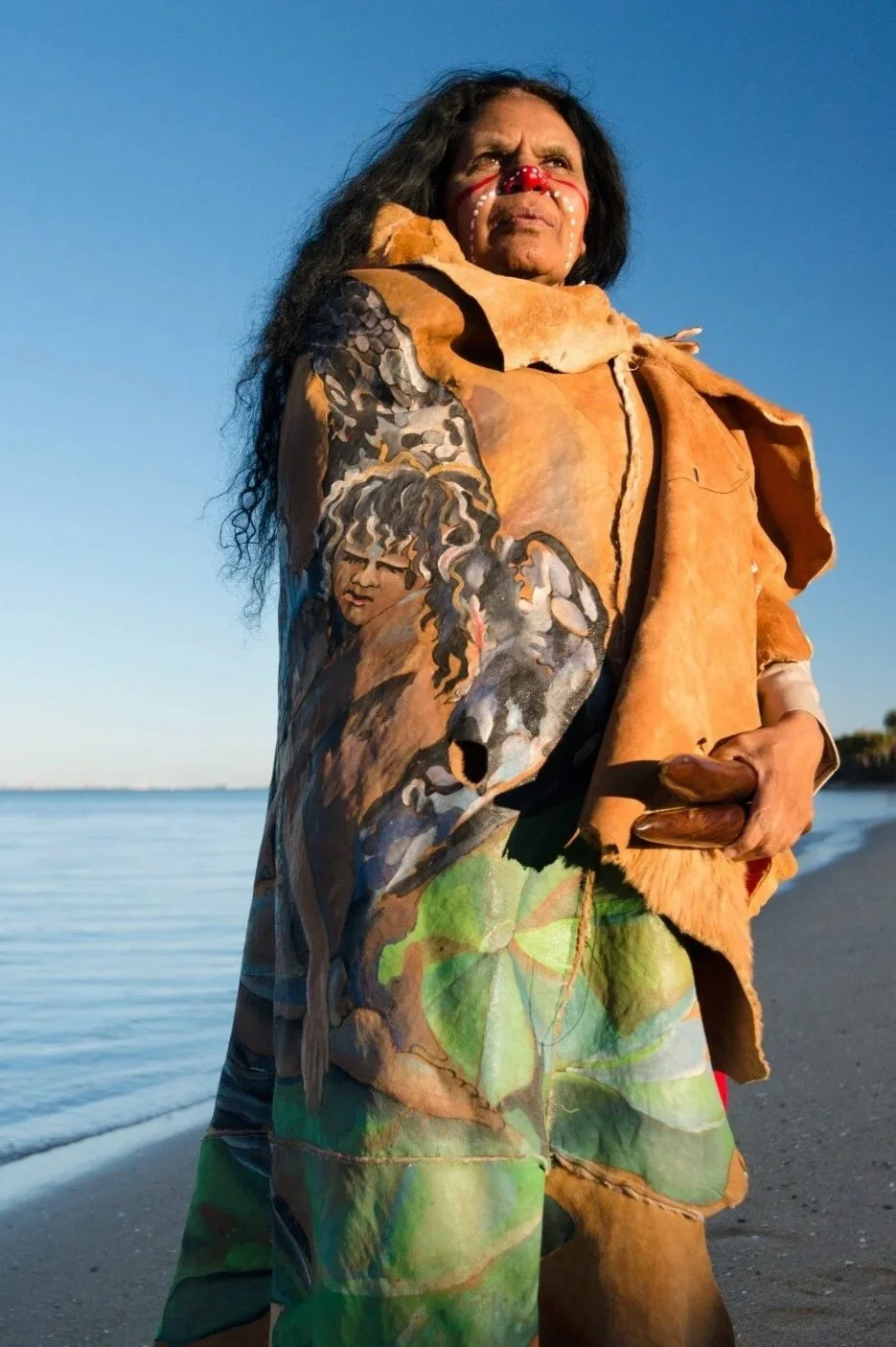
Songwoman Maroochy Barambah (1955–2026)
Songwoman Maroochy Barambah was a respected Turrbal Songwoman, Law-woman, cultural leader, and internationally recognised performer who dedicated her life to sharing culture, strengthening community, and honouring Country.
Born Yvette Olga Isaacs on 12 February 1955 at Cherbourg Aboriginal Mission in Queensland, Maroochy was of Turrbal, Gubbi Gubbi, Wakka Wakka, Kamilaroi and Birri Gubba ancestry. Her life journey reflected resilience, cultural pride, and a deep commitment to ensuring Aboriginal voices, stories, and traditions were heard and respected.
Across more than five decades, Maroochy shared her extraordinary voice and cultural knowledge through music, performance, ceremony, and education. She studied at the Melba Conservatorium of Music and the Victorian College of the Arts, and her artistic career spanned opera, theatre, television, and contemporary music. She appeared in the groundbreaking musical Bran Nue Dae, the television series Women of the Sun, and performed internationally, including at the United Nations during the International Year of the World’s Indigenous Peoples.
Maroochy also broke important barriers in the arts, becoming the first Aboriginal performer to take a leading role on the Australian operatic stage in Black River, a powerful production addressing deaths in custody. Through her work, she used art as a bridge between cultures and as a platform for truth-telling and understanding.
Beyond the stage, Maroochy was deeply committed to cultural leadership. She played an important role in supporting the Turrbal People throughout the Native Title journey and dedicated many years to delivering cultural education programs and Welcome to Country ceremonies. Her voice welcomed global leaders to Turrbal Country at the 2014 G20 Summit in Brisbane and she delivered the Welcome to Country at the Gabba during the Sydney 2000 Olympic celebrations, honouring Turrbal Country on an international stage.
Maroochy also contributed to language revitalisation, including presenting the Australian national anthem in the Turrbal language, reinforcing the importance of language as a living expression of culture and identity.
For the Turrbal community, Maroochy was more than a performer or cultural educator. She was a mentor, matriarch, and custodian of cultural knowledge who encouraged younger generations to stand proudly in their identity and continue carrying culture forward.
Songwoman Maroochy Barambah passed away in January 2026 following a courageous battle with cancer. Her passing marked the loss of a respected Elder, artist, and cultural leader whose influence touched communities across Australia.
The cultural responsibilities carried by Songwoman Maroochy continue through her family and the Turrbal community who continue to honour her legacy by delivering Welcome to Country ceremonies and sharing language, culture, and the stories of Turrbal Country with respect and authenticity.